AI Data Transform
AI Data Transform reshapes data into the format you need. Give it up to three plain-language instructions and it hands back one answer per instruction, in the order you wrote them.
It is at its most useful on text with no fixed shape, like a customer email, a scanned receipt or a meeting transcript. You do not need to know how the data is formatted underneath.
AI Data Transform or AI Prompt?
Both use Glow’s managed models, and both see only the data you reference. AI Prompt makes one model call; AI Data Transform makes one concurrent call per instruction. The other difference is the shape of what comes back:
| You want | Use |
|---|---|
| Up to three ordered values from one text | AI Data Transform: one positional answer per instruction |
| One answer, worded or structured your way | AI Prompt: a single result you shape with Response shape |
For a single value, either works. AI Data Transform needs less setup; AI Prompt gives you control over the answer’s wording and structure.
Setting it up
Add the step
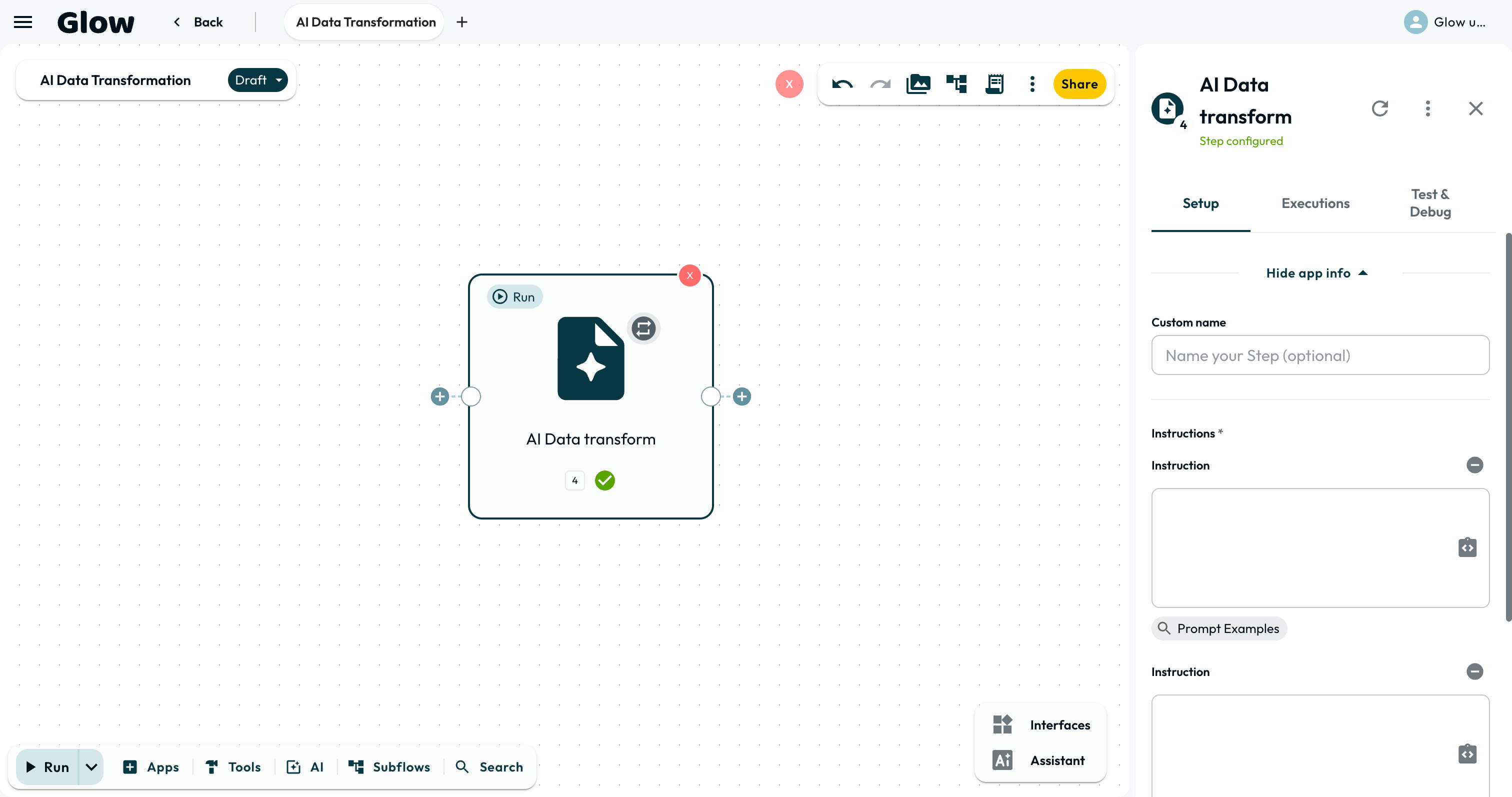
Open Tools in the dock and choose AI Data Transform. On the canvas, right-click and pick it under Data.
Write one instruction per value
The step has one field: Instructions, a list you can add up to three entries to. There is no separate input box. For a fourth value out of the same text, use AI Prompt with Response shape, which takes one field per value you want back. You point each instruction at the text by step number, the same way you reference a value anywhere else:
Extract the customer’s order number from
{{ 2.ret.body }}
The step sees only what your instruction references. Use the data picker to insert the reference rather than typing it: the path depends on which step produced the text.
What it passes on
The step returns one answer per instruction, in the order you wrote them:
| Reference | What it holds |
|---|---|
{{ N.result.0 }} | the answer to your 1st instruction |
{{ N.result.1 }} | the answer to your 2nd instruction |
{{ N.result.2 }} | the answer to your 3rd instruction |
Because the answers are positional, reordering your instructions changes what every later reference points at. If you want values you can address by name, ask a single instruction to return JSON and use Parse JSON on the result.
Limits
You can add up to three instructions. For a fourth value from the same text, use AI Prompt with Response shape, which returns named fields in one result.
How accurate the answers are depends on how clear the source text is. Give it a smudged scan or an ambiguously worded email, and the answer may be confidently wrong.
For anything that costs money or cannot be undone, put a Human Review step between the extraction and the action. A person then sees the values before they are used.
Examples to copy
Reach for AI Data Transform when the information you need is in there somewhere but never in the same place twice:
- A receipt or invoice: instruction 1 asks for the supplier, instruction 2 the total, and instruction 3 the due date. Read them as
{{ N.result.0 }},{{ N.result.1 }}and{{ N.result.2 }}. - An inbound email: extract the sender’s job title, their company size and what they are asking for.
- A meeting transcript: extract the owner, the agreed action and its due date.
If the text always arrives in exactly the same shape, Split Text or Parse JSON will do the job faster and without an AI call.
What’s Next?
- Need one shaped answer instead of positional values? AI Prompt.
- Put a reviewer in front of important extractions with Human Review.
- For work that needs several steps of judgement rather than one extraction, use the AI Agent.