Managing Connections
The Connections page is the central place to find apps, add your own accounts and manage the connections you created.
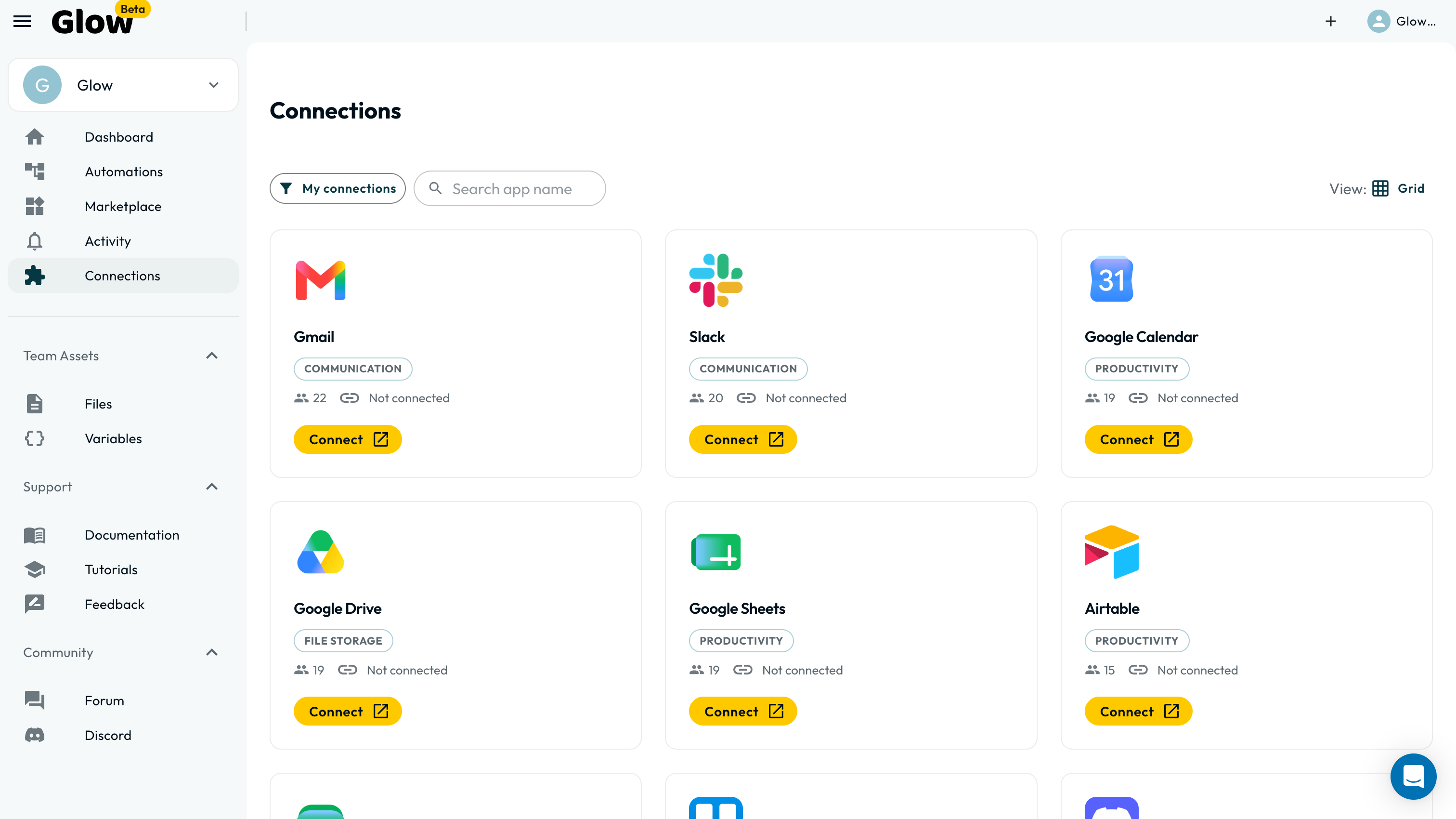
Viewing All Connections
Open Connections from the left sidebar. The page shows one card per app. A card gives you the app’s name, its category, and either the connected account’s email address or Not connected.
Three controls narrow the page down. My connections filters to the apps you have already set up, the search box finds one by name, and the view toggle switches between grid and list.
Connection Status
A card reads one of two ways: the connected account, shown in green, or Not connected.
The card names the account; whether its access still works is checked where it matters, at the step that uses it. A step whose account has lapsed names it and offers a Reconnect button in the App drawer.
Disconnecting a Connection
Only the person who created a connection can disconnect it. Other workspace members can use an available connection in a workflow, but they do not see its lifecycle actions.
- Find the app’s card on the Connections page.
- Click Disconnect.
- Confirm.
Tip: Before disconnecting, check which workflows use this account. Disconnecting causes any step that references it to fail on its next run.
Reconnecting
Glow does not flag a dead connection on the Connections page. You find it in the workflow instead. Open the step that uses the account, and the App drawer names the broken connection, “<account> is no longer authorized”, with a Reconnect button beside it.
Clicking it re-runs the sign-in and re-points the step at the refreshed connection.
Multi-Account Support
Glow allows you to connect multiple accounts for the same app. This is useful when:
- You manage workflows for different clients, each with their own Google Workspace.
- Your team uses separate Slack workspaces for internal and external communication.
- You need to read from one Salesforce org and write to another.
Adding a Second Account
The quickest route is from inside a step. Open the Account dropdown in the App drawer and choose Connect new account…, which is offered whether or not you already have one. Sign in with the second account, and the step points at it straight away.
Selecting Between Accounts in a Workflow
Configure a step for an app with multiple connections and the Account dropdown lists every one of them. Select the one appropriate for that particular step.
For example, say you have two Google Sheets connections, one for [email protected] and one for [email protected]. One step can read from an operations spreadsheet while another writes to a marketing spreadsheet, all within the same workflow.
Where Connections Appear in the App drawer
When you add or edit an app step, its App drawer includes:
- Account: a dropdown listing all connections for the selected app. This is where you choose which account to use.
- Action: the specific operation to perform (for example, “Add Single Row” in Google Sheets).
- Configuration fields: the inputs required by the selected action, which may reference data from previous steps.
The Account dropdown always offers Connect new account… at the bottom, so you can sign in to a new account without leaving the workflow editor.
Best Practices
- Know which account is which before you connect it. A connection is labelled with what the provider returns, usually the account’s email address. Signing in with an address that makes its purpose obvious (
billing@,alerts@) is what tells two connections apart later. Where a provider returns no address at all, the card reads “Connected”. That is another reason to connect accounts one at a time, in an order you will recognise. - Review connections periodically. Remove connections that are no longer in use to keep your Connections page clean and keep the list to what you actually use.
- Coordinate with your team. A connection can be selected in workflows across the workspace, but only its owner can reconnect or disconnect it. Disconnecting affects every workflow that references it.
What’s Next?
- Add a service you have not authenticated yet in Connecting an App.
- See how workspace roles, workflow visibility and delegated access fit together in Permissions and Access.