Scheduler Trigger
The Scheduler trigger starts a workflow on a repeating schedule. It is what you use for daily reports, hourly data syncs, and weekly cleanups.
You type the schedule the way you would say it: “Every Monday at 9:00 AM”. It handles recurrences a rigid interval picker cannot express, such as “the last Friday of each month”, and shows you the next few run times, so you can confirm it read you correctly.
Schedule mode offers a second way in: switch it from AI Assistant, the plain-language description, to Manual Cron and write a cron or RRULE expression by hand. It takes a 5-field cron like 0 9 * * 1-5, a 6-field cron with leading seconds, or a raw RRULE. Reach for it when you already have the expression, or when the wording keeps being read as something else.
Both modes drive the same trigger, and it goes down to a 10 second interval. Each firing spends a credit, as does every step the run then takes, so the interval you pick is what shapes the cost.
How it works
You describe a schedule, for example “every day at 9:00 AM” or “every 15 minutes”. Glow works out the recurrence and starts a new run of the workflow each time it comes round.
The trigger itself carries no data. It only says the schedule came round. When a later step needs a timestamp, use {{ $now }} for the full date and time or {{ $today }} for the date. Both resolve at the moment that step runs, not when the run started.
Setting up a Scheduler trigger
- Open your workflow in the editor.
- Open Tools in the dock; Scheduler sits under Start.
- Drag the Scheduler trigger onto the canvas, or click it to add it.
- In the configuration panel, type the schedule into Schedule description in plain words. “Every weekday at 8:00 AM”, “every 15 minutes”, “the first of every month at midnight”.
- Open Optional Props and set Timezone, so the time means what you expect. Left empty, the schedule runs in UTC.
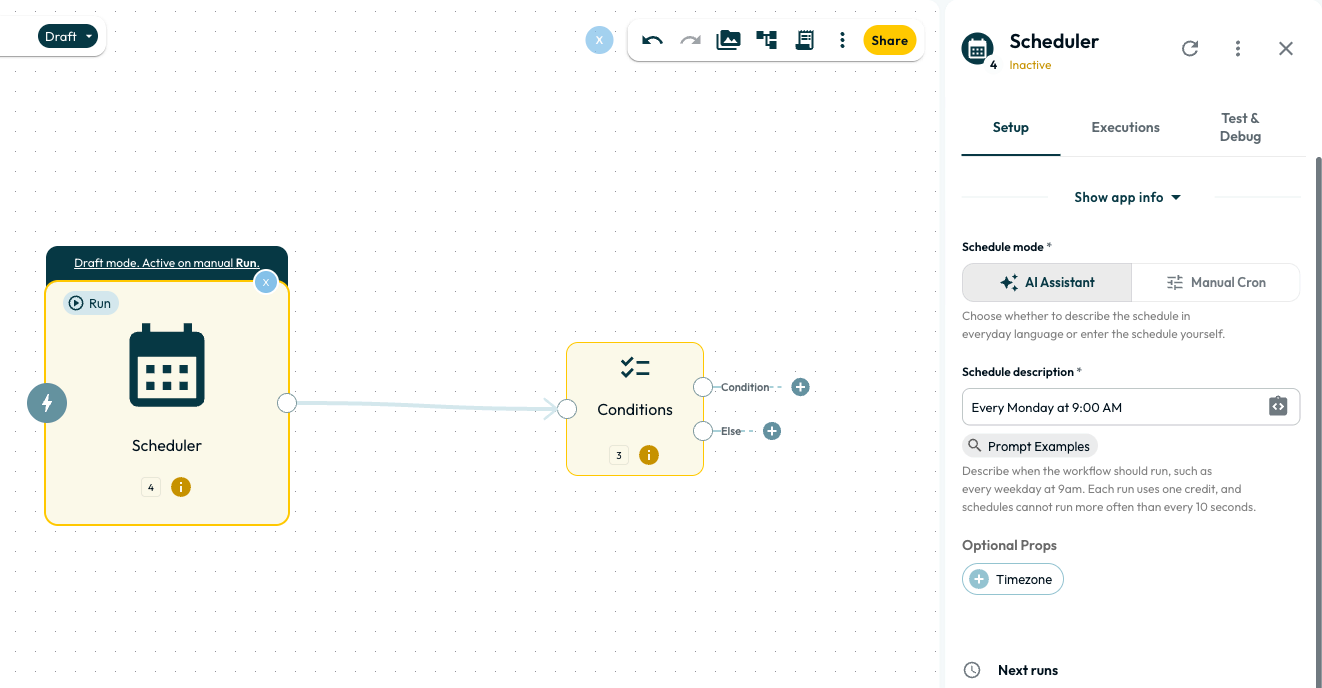
What you can type
The field takes plain language and works out the recurrence from it. Sentences like these all work:
Every day at 9:00 AMEvery hour on the hourEvery 15 minutesEvery weekday at 6:00 PMThe first of every month at midnightThe last Friday of every month at noon
Write the time as you would say it out loud, name the days you mean, and be explicit about AM or PM. The Examples button beside the field shows more accepted phrasings.
The panel shows the next few run times once it has read your sentence. Check them before you go live: if they are not what you meant, reword the sentence rather than hunting for a syntax.
Time zones
Leave Timezone empty and the schedule runs in UTC. That is rarely what you want: “9:00 AM” then means 9:00 AM UTC, not 9:00 AM where you are.
Open Optional Props on the trigger and set Timezone to your region, such as Europe/Warsaw or America/New_York. Do it when you create the trigger, rather than after someone asks why the report landed at 4 AM.
Tip: If your team spans multiple time zones, document which time zone each scheduled workflow uses so everyone knows when to expect the output.
Practical examples
Daily report generation
Set a Scheduler trigger to run every weekday at 8:00 AM. The workflow reads your database or analytics tool and compiles a summary. It then sends that to a Slack channel or an email list before the team’s morning standup.
Hourly data sync
Set a Scheduler trigger to run every hour. The workflow pulls new records out of one system, such as a CRM, and writes them into another, such as a data warehouse. That keeps both in sync throughout the business day.
Weekly cleanup
Set a Scheduler trigger to run every Sunday at 2:00 AM. The workflow scans for stale records, archives completed items, and sends a summary of what was cleaned up to the operations team on Monday morning.
Common pitfalls
Overlapping runs
If a workflow takes longer to run than the gap between scheduled runs, the next run starts anyway. The previous one does not have to finish first. On short intervals such as every minute, keep the workflow fast. Or add a check early on that skips a run when one is already in progress.
Confirming a Run Actually Happened
A scheduled run fires at its time or not at all. There is no catch-up replay for an occurrence that did not start. Where a skipped day matters, have the workflow write a line to a sheet or a Slack channel on each run. A missed day then shows up as a missing line. The run history on the workflow shows the same thing.
Choosing the interval
The Scheduler goes down to 10 seconds, which covers everything from a near-live sync to a monthly report. Since a credit is spent per step that runs, the interval is the main thing that decides what a schedule costs you: an hourly check does the same job as a per-minute one for a fraction of the allowance, whenever the data does not actually change that often.
Pick the longest interval that still meets the need. Confirm the downstream systems and any API rate limits can handle the load, and check your plan’s allowance in System Limits & Quotas.
Daylight Saving Time
Glow follows the time zone configured on the trigger. During daylight saving transitions (clocks moving forward or backward):
- Schedules falling within the 1:00 AM – 3:00 AM window may run twice or be skipped depending on the local shift.
- Best Practice: Schedule critical automations outside the 1:00 AM – 3:00 AM window, or set the trigger timezone to UTC to avoid clock shifts entirely.
What’s Next?
- Start a workflow from an external event instead of a clock with the Webhook Trigger.
- Check your plan’s run allowance in System Limits & Quotas.