Activity
Activity answers: What happened across the workspace, and which runs or alerts need attention? Use it for workspace-wide monitoring and ownership. For the run history of one open workflow, use its Execution Log; open a Step’s Executions tab only when you need recorded input and output.
Open Activity from the sidebar. When alerts are waiting, the number appears beside it, so you can see there is something to deal with without opening the page.
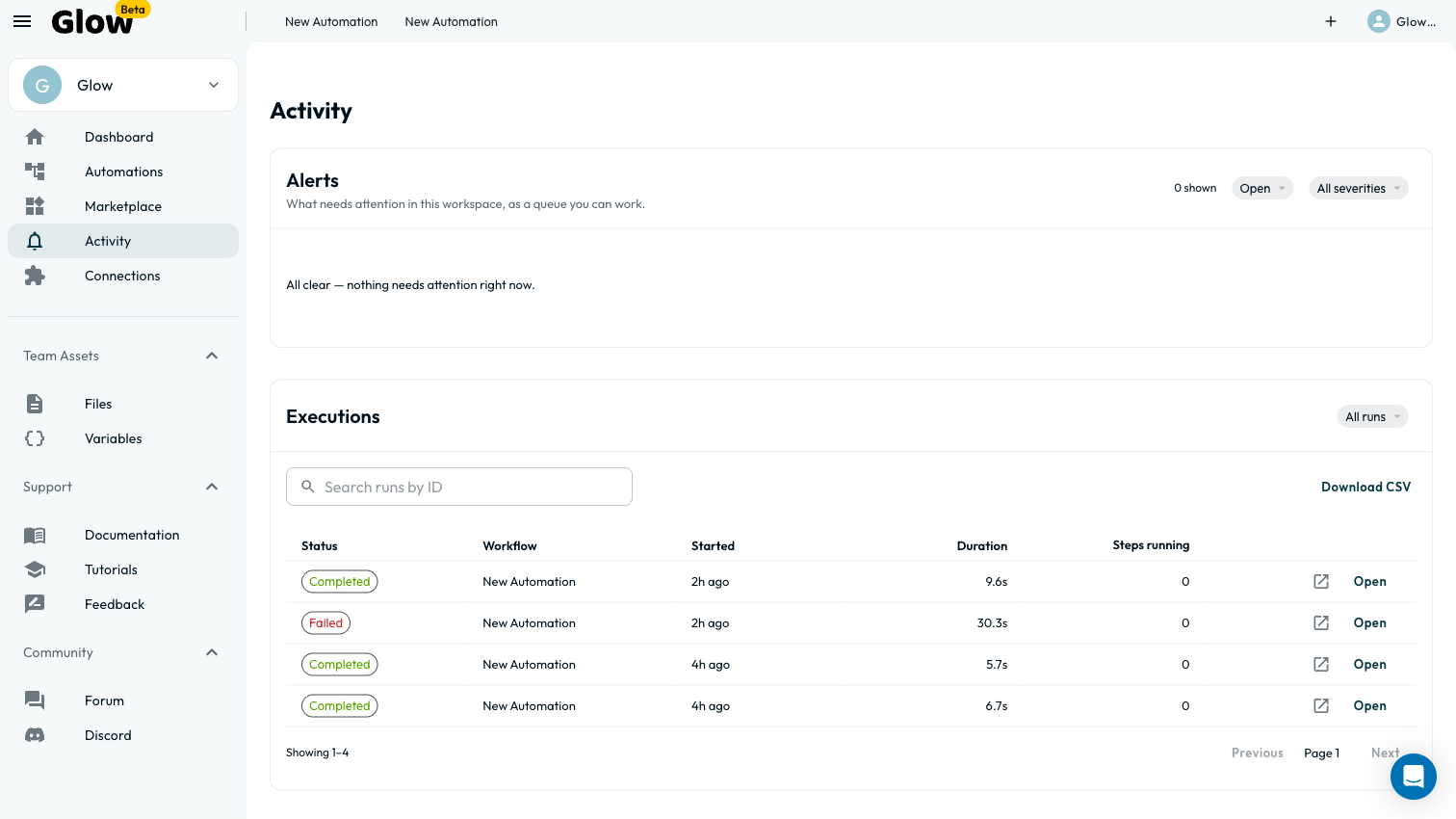
Two-Column Activity Layout
The Activity page presents a unified two-column dashboard:
- Executions (left column): Recent workflow runs across the workspace, with status, start time, duration and step progress.
- Needs Attention (right column): Open operational alerts that your team can acknowledge, assign or resolve.
Smart Alert Counting
The red badge beside Activity shows how many new alerts have not yet been acknowledged. Acknowledging an alert clears its unread state, but the alert remains Open until somebody marks it resolved.
Alerts & Needs Attention
Filter alerts by Open, Resolved or All statuses, then narrow them by High, Medium or Low severity. Open includes both new and acknowledged alerts.
| Action | What it does |
|---|---|
| Acknowledge | Records that somebody has reviewed a new alert. It remains in the Open queue. |
| Assign | Gives the alert to you or another workspace member. Assignment also acknowledges it; choose No one assigned to clear ownership. |
| Open in canvas | Opens the affected workflow when the alert points to a workflow, trigger or scheduler problem. |
| Mark as resolved | Removes the alert from the Open queue. Filter by Resolved to review it later. |
Other alert types take you to the setting that needs attention, such as Connections, Team Settings or subscription management. If the same condition occurs again after resolution, Glow can create or reopen an alert for the new occurrence.
Executions Table
The executions table lists recent runs for workflows you can access. Filter by All runs, Running, Failed, Completed or Canceled, or search for an exact execution ID or correlation ID.
Open a row to see its workflow, timing, step timeline, attempts, error summary and related runs. Use Open in canvas when you need the step inputs and outputs.
Download CSV exports the current page of 25 rows, after applying the active status filter or ID search. It does not download every page of workspace history or the Needs Attention queue. Execution history follows the workspace retention policy, and each run keeps the policy that was active when it started. See Data Retention.
From a run to one Step
Activity owns the whole-run view across the workspace. Open Open in canvas for the affected workflow, then select the relevant Step and use its Executions tab for Step input, output, and attempt details.
What’s Next?
- 👉 Step-Level Executions →: inspect the input and output of the Step that needs attention.
- Error Handling & Retries: configure future retry and error-route behavior.
- Troubleshooting & Common Errors: look up a symptom or exact error message.