Navigating the Dashboard
Signing in puts you in a workspace, on its dashboard. Everything else is one click away in the sidebar down the left.
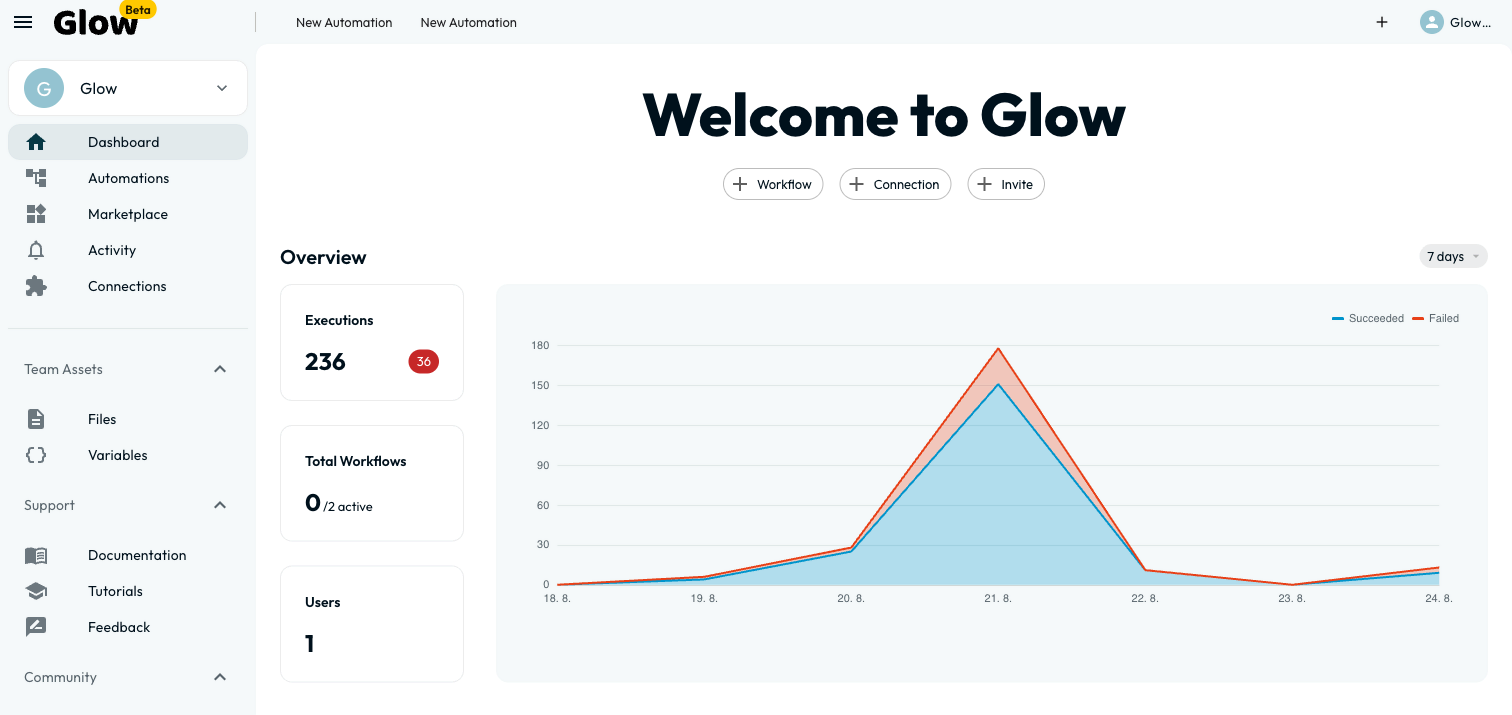
On a brand-new workspace the dashboard opens with a box to describe the workflow you want, alongside templates to browse and a short tour. Once your automations have run a few times, that gives way to the panel below: what ran, what needs attention, and what is live.
The sidebar
The sidebar down the left holds everything in the workspace. Your workspace name sits at the top; clicking it switches to another.
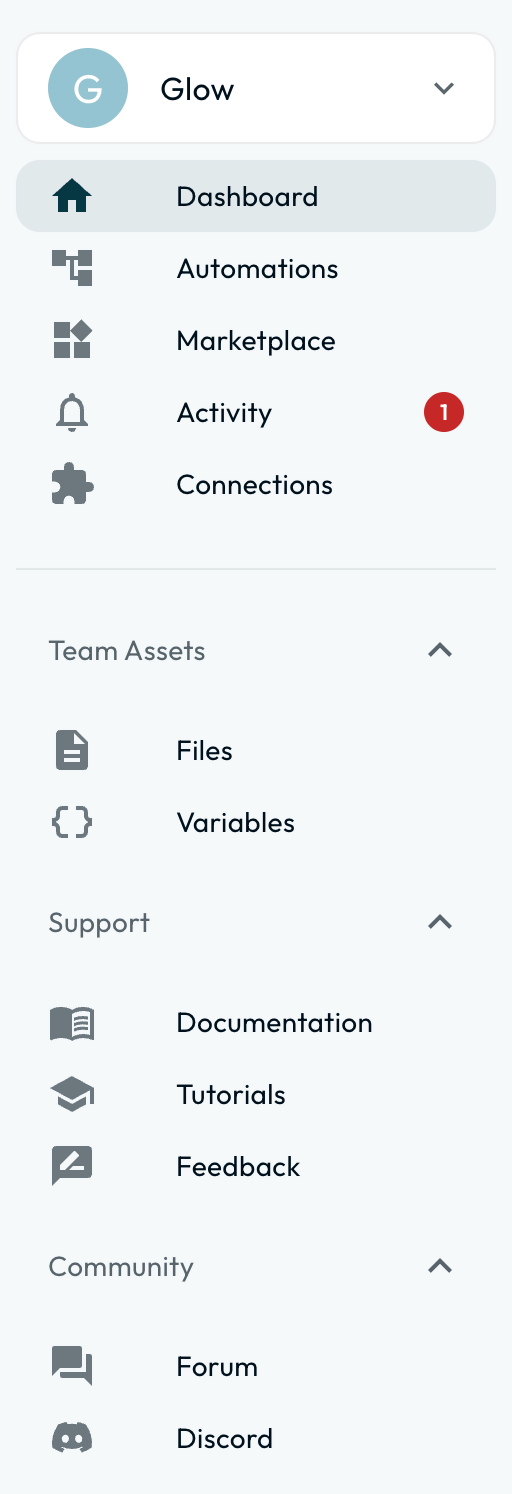
| Item | What it holds |
|---|---|
| Dashboard | Runs over the last few days, how many workflows are live, and what ran recently. |
| Automations | Your workflows, as cards or a list. Each shows its run count and whether it is Draft or Live. At the top, “What would you like to automate today?” takes a plain-language sentence and drafts the workflow for you, often the fastest way to start. |
| Marketplace | The public template gallery. |
| Activity | Alerts needing attention and every run in the workspace, with a count on the item when alerts are waiting. See Activity. |
| Connections | The apps this workspace has connected, and the full library you can connect. |
Below those, three groups that fold away:
| Group | What is in it |
|---|---|
| Team Assets | Deployment, every workflow you have published and where it is live; Files your workflows read at run time; and Variables: team variables and secrets, sharing one table. See Secrets and Variables. |
| Support | This documentation, video tutorials, and a way to send feedback. |
| Community | The forum and the Discord server. |
The header
Two things live along the top:
- Open workflows: tabs for the workflows you have open, so you can move between them without going back to the list.
- Your name, top right, which opens your account settings.
The workspace menu
Clicking your workspace name at the top of the sidebar opens a short menu.
| Item | What it does |
|---|---|
| Manage team | Invite people, set roles, and see who is in the workspace. See Team Management. |
| Billing & Usage | Usage and pricing for every workspace role; financial details and billing management for Admins. See Billing & Usage. |
| Other teams | Every workspace you belong to, and Create new to start another. |
Finding your way around
| Task | Where to go |
|---|---|
| Create a workflow | Workflow on the dashboard, or Create new under Automations |
| Import from n8n or Make | Import JSON under Automations |
| Group workflows together | Create new → New Folder under Automations |
| Find a deleted workflow | Filter → Archive under Automations |
| Connect an app | Connections |
| Store an API key | Team Assets → Variables |
| Upload a file a flow uses | Team Assets → Files |
| See what you have published | Team Assets → Deployment |
| See what needs attention | Activity |
| Export a list of runs | Activity → Download CSV |
| Invite a teammate | Invite on the dashboard, or workspace menu → Manage team |
| Check credit usage | Workspace menu → Billing & Usage → Usage |
| Switch workspace | The workspace name at the top of the sidebar |
| Browse templates | Marketplace |
| Change your password | Your name, top right |
Keeping the list manageable
Folders
Group workflows under Automations:
- Click Create new → New Folder, choose a name, and select a color.
- Drag workflow cards onto the folder to move them in.
- Open any folder and create nested folders as needed.
Note: Folders organize your view; they do not change workspace permissions.
Archive
Deleting a workflow moves it to Archive with a 30-day recovery window.
- Restoring brings the workflow back switched off to prevent unintended executions.
- Deleting directly from Archive is permanent.
Deleting a workflow moves it to Archive rather than removing it, and you can restore it from there for 30 days. Each card shows the date it will be removed on. A restored workflow comes back switched off, so it does not start running the moment it returns. Deleting from Archive yourself is immediate and permanent. Archive is a way back from a mistake, not a place to keep something — to hold a workflow indefinitely without it running, leave it in Automations switched off.
What’s Next?
- Set up who can do what in Setting Up Your Team.
- Build something with the step-by-step tutorials.