What Is Glow?
Glow is a visual workflow automation platform for teams that build together. It connects the apps and data behind a business process, runs the work automatically, and gives consultants and MSPs a separate governed workspace for each client.
A workflow might start when a form is submitted, on a schedule, or when a record changes in a connected app. On the canvas, a trigger starts the run, the steps after it make decisions and take action, and each step can use data produced earlier.
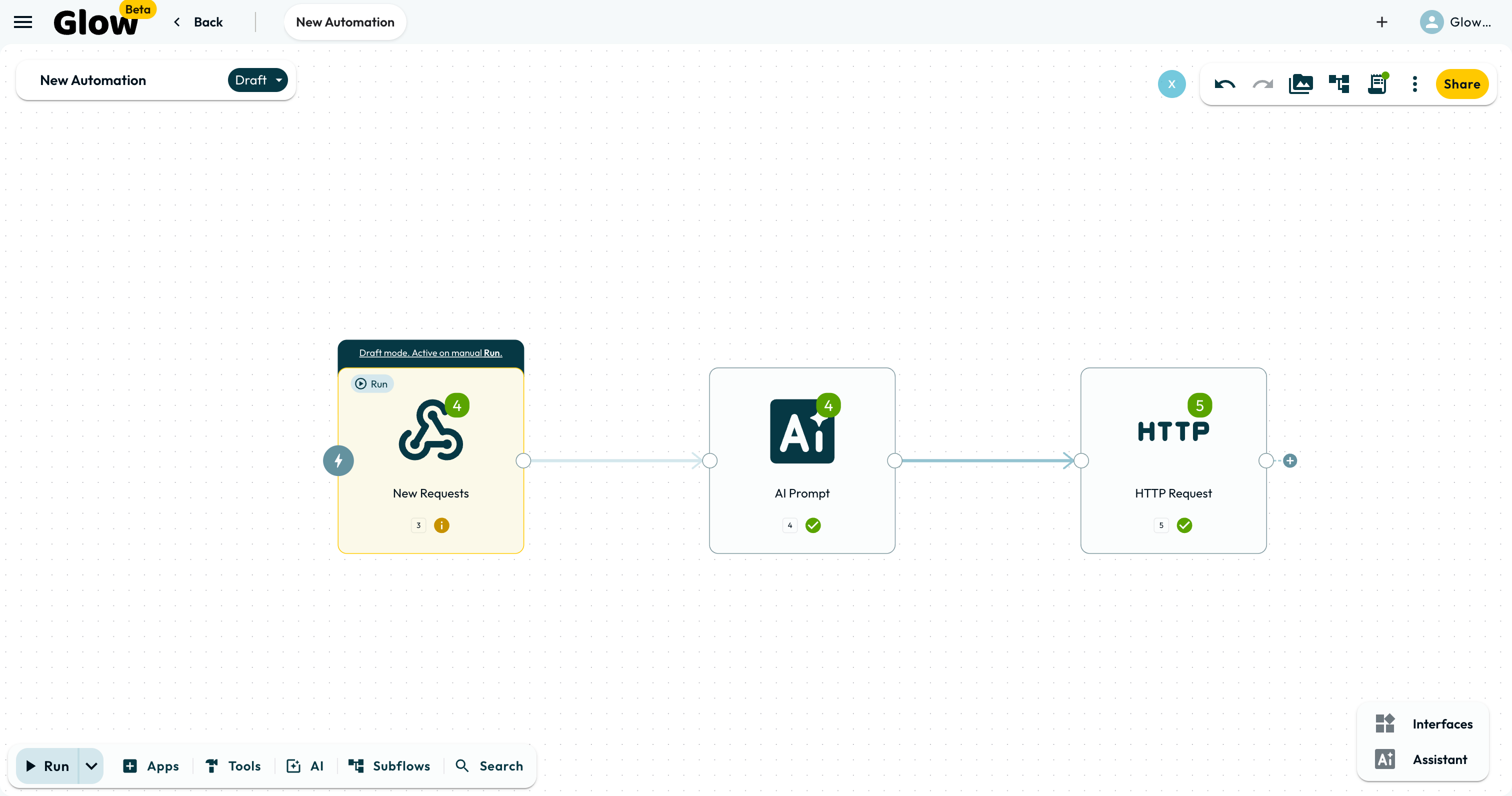
The shape of every workflow
Every automation in Glow starts with a trigger and continues through steps that do the work. Add logic between them when the process needs to transform, route or repeat data:
A workflow stays readable because that model remains visible on the canvas. You can inspect what each step received, what it returned and which route the run took.
What makes building in Glow different
Your team works on the same live canvas
Several people can open and edit one workflow at the same time. Their cursors show where they are working, and changes appear for everyone as they happen. Different fields can be edited without one person waiting for another to finish.
That makes the canvas useful for more than initial construction. A team can investigate a run together, explain a process to its owner, or divide a larger workflow into branches without passing files around. See Real-Time Editing.
The Workflow Assistant builds where you build
Describe an automation in plain language and the Workflow Assistant places, connects and configures steps on the same canvas. You can keep editing while it works, then review and test what it produced before switching the workflow to Live.
The Assistant is for creating and changing the workflow. AI steps inside the workflow are different: they make a judgement each time a run reaches them.
AI is one part of a reliable workflow
Use regular steps when the rule can be written down and the same input should produce the same result. Use an AI step when the work requires interpretation, such as classifying a support request or extracting fields from an unfamiliar document.
The common design uses both. AI interprets the uncertain input; ordinary steps route the answer and perform the final action. Add Human Review before an important write or send when a person should approve the result.
Client work stays in the client’s workspace
Consultants and MSPs can work across separate client workspaces rather than combining every customer’s automation and credentials in one account. Each workspace holds its own workflows, connected accounts, secrets, files and run history.
Access is governed through a grant the client can review, narrow or end. When you deploy a workflow to clients, each selected workspace receives an independent Draft copy for its own accounts and review. See How Multi-Tenancy Works.
The building blocks you will use
- Triggers start a workflow from a webhook, schedule or event in a connected app.
- Actions send messages, update records and call the services where work happens.
- Control flow uses Conditions, Switch and loops to choose and repeat work.
- Data mapping carries a value from one step into another. Data Transformation changes that value as it moves.
- Draft and Live separate manual testing from automatic triggers. Versions give you a known state to restore.
- Execution details show the route, input and output of each run so you can verify and troubleshoot it.
Where AI belongs
A useful rule is to ask whether the decision can be written down.
- Route invoices over 5,000 to finance
- The same input must produce the same output
- The step runs frequently and cost per run matters
- A wrong result would be expensive
- Classify the tone or intent of a message
- Extract useful fields from varied documents
- Draft text from the context collected so far
- A person can review a high-impact result
For example, an AI step can classify an incoming support ticket. A Conditions step then applies an exact routing rule, Slack alerts the right team, and the help desk record is updated. Only the classification needs AI; the rest stays predictable.
What you can build
Receive a lead, route it by an exact business rule and bring the branches back into one record.
Lead RoutingUse AI to classify the request, then apply exact rules to update the ticket and alert a person when needed.
Support Ticket TriageExtract structured fields from a document, pause for approval and write each approved line to its destination.
Invoice ProcessingWork inside a client’s separate workspace, test with their accounts and leave the workflow ready for the client to own and operate.
Client AutomationWhat’s Next?
- 👉 Build Your First Workflow →
- Choose a workflow shape or Step family in Choose the Right Step.
- Learn the underlying model in What Is a Workflow?.